30th January 2019
This run of sea days didn’t start well for me. I visit the gym each day in an effort to burn off some of the vast number of calories one inevitably consumes on a cruise (it takes a will stronger than mine to resist), and though I no longer push myself as hard as I did in my younger days, I managed to strain my knee on the running machine. Annoyingly, I now have to rest it for a few days and watch what I eat. Fingers crossed for that!
On the Columbus, we see more of the captain than on any other ship we’ve sailed on. He is frequently spotted throughout the day and evening at various locations around the ship, chatting amiably with passengers and crew alike while keeping a watchful eye on proceedings. His presence keeps the crew on their toes and sets a fine example of leadership for all on board. I suspect that, unlike the captain of the Costa Concordia, this one would be the last to leave a sinking ship, not the first. As evidence of how tightly he runs things, we had our third lifeboat drill of the voyage on the 31st.
That afternoon, I managed to get online and discovered that Sarah and Lee had exchanged contracts on their new house and had begun moving in, a huge relief for them, as it had seemed quite likely that their chain would collapse at the last minute. I imagine moving on the coldest day of the year so far was the least of their concerns! Keeping up with family news and uploading blogs has been difficult, as the WiFi out here in the Pacific is pretty poor, very slow and frustratingly intermittent. Then again, I suppose seabirds, turtles, and flying fish have little use for the technology. On a positive note, I am back in the gym, battling the bulge, though I’m steering well clear of the running machine.
Fittingly, we crossed the Equator on the 1st of February. This is hardly an event when flying, but on a cruise ship, it provides the perfect excuse for frivolity. On other cruises we’ve been on, there has been a party, preceded by a short ceremony where King Neptune (a suitably costumed crew member) welcomes everyone to his kingdom, usually culminating in an extremely long conga around the ship’s decks, both inside and out. Columbus does things differently. Neptune still takes centre stage, but he has a supporting cast of pirates, mermaids, and doctors. Four crew members who had never crossed the Equator before were taken prisoner by the pirates and put on trial, facing amusing, trumped-up charges. After being found guilty, they were required to kiss an enormous fish (fresh from the kitchen) before being strapped to an operating table, where their punishment consisted of being covered in eggs, ice cubes, baked beans, flour, and, finally, milk. Suitably humiliated, they were then unceremoniously dumped into one of the ship’s swimming pools. The pool then had to be emptied, cleaned, and refilled, a process that took most of the day! A very amusing way to mark what is, I suppose, a significant milestone in the careers of the hapless participants.

As we’ve been making our way around the globe, we’ve regularly been putting the clock back an hour every few days. So far, we’ve done this ten times. Surprisingly, though we gain an extra hour in bed, we always seem to sleep soundly until our 8 am alarm, regardless of what time we turn in.
We have an internal cabin, so when the lights are off, it’s pitch black. Combined with the ship’s gentle (so far) motion, there’s nothing to give our internal clocks any sense of time, no daylight, no sounds other than the occasional random creak as the ship flexes against the swell. However, on 2nd February, we had to put the clocks back by half an hour. Sue had no problem with this, but when the alarm went off, I was completely thrown and just couldn’t wake myself up properly until later in the morning, and after several cups of coffee!
Almost as baffling was England’s 12-point victory over Ireland, at rugby, in Ireland! Now, who saw that coming?

On the 4th, we should have woken to breakfast while anchored off the small French Polynesian island of Nuku Hiva, but it was not to be. Unbeknownst to the passengers, at 12:30 am, the ship had received a distress call from the yacht Chismosa, sailing out of San Francisco. She had lost her mast, there was an injured person on board, and she was running low on fuel, stranded far from the usual shipping lanes.
With Columbus being the only vessel remotely nearby with the necessary facilities for a rescue, the decision was made to reverse course and steam for ten hours to intercept the stricken yacht. While this drama unfolded, we passengers slept on, blissfully unaware. It was only as Sue and I made our way to breakfast that we began to hear rumours. We were still at sea, not anchored off the island as expected.
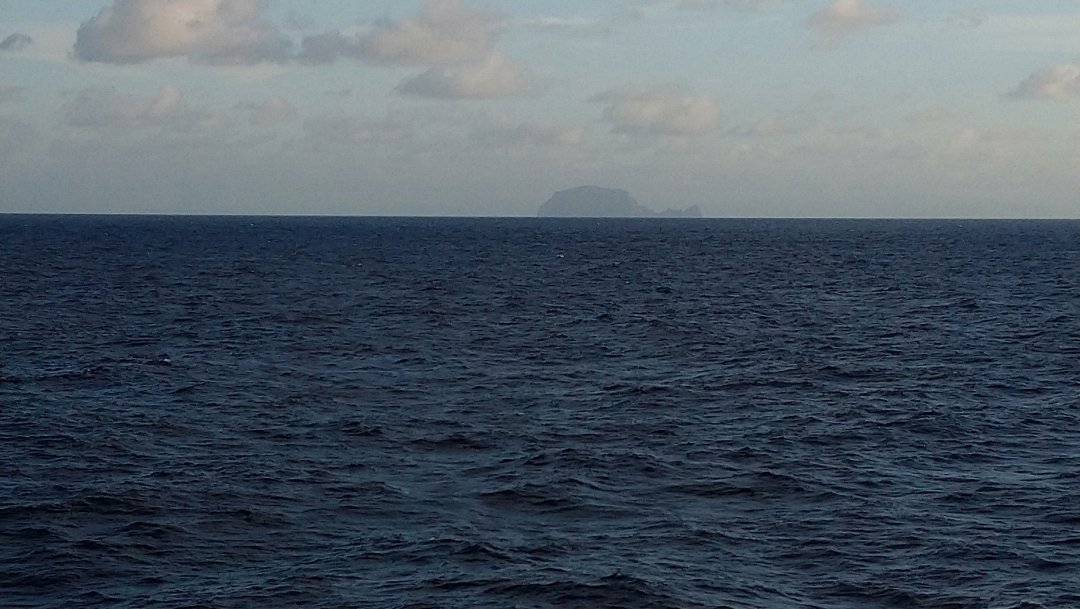
Venturing onto the deck, it soon became clear what was happening. We watched as one of the ship’s tenders was launched and headed towards a small white speck in the distance. Columbus was now proceeding at ‘dead slow’ towards the gradually recognisable outline of a vessel.
I returned to the cabin for my camera and binoculars. Through them, I could see three people on deck; the mast was clearly missing, the shrouds either cut or snapped, and the safety rail badly mangled. An elderly gentleman with cuts and bruises on one arm sat quietly in the cockpit, coiling ropes. A younger man stood at the helm, attempting to steer towards the cruise ship, while a young woman sat on the cabin roof, looking visibly relieved.
The tender didn’t attempt to board the yacht or attach a tow rope but remained a few metres away, waiting as Columbus drew closer. The yacht still had some power and, despite the growing swell, was able to motor towards the small lower deck where port pilots embark and disembark. Once alongside, ropes were secured, and crew members boarded the stricken vessel.
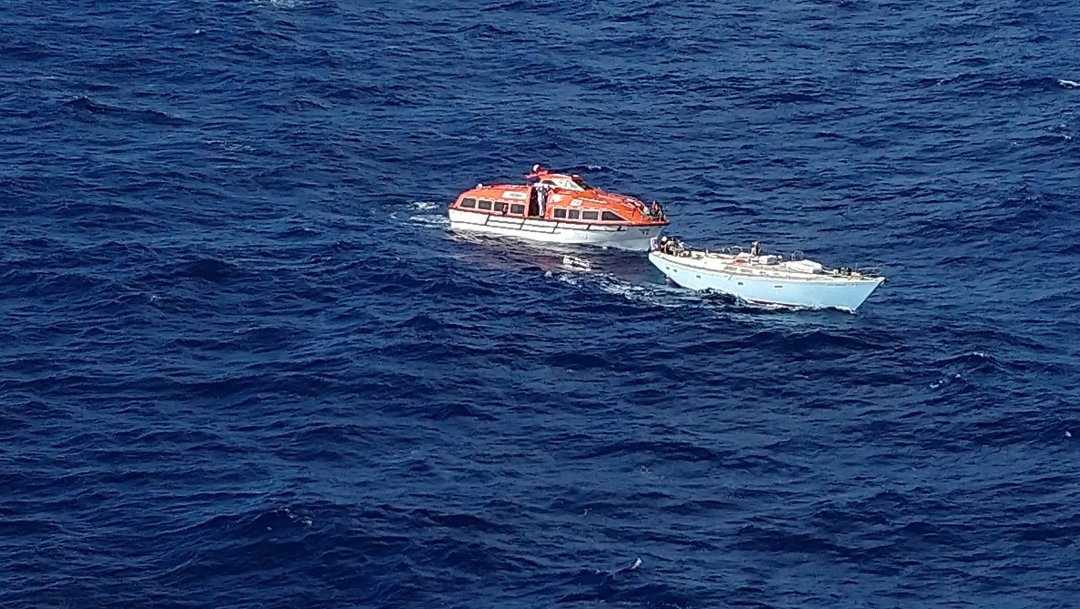
There was much discussion before barrels of fuel oil were finally seen being poured into the yacht’s fuel tank. This was a slow and careful process, as the swell caused the liquid to slosh around in the funnel, constantly threatening to spill over the deck and into the sea.
Once refuelling was complete, crew members carried out thorough checks on the vessel, no doubt to assess her seaworthiness. I suspect our captain would not have allowed her to continue towards the nearest port unless he was confident she could make the journey safely.
Eventually, with everything seemingly in order and all concerns addressed, the yacht was released from her moorings. She gently motored aft, accompanied by the ever-watchful tender. The immediate danger had passed. With a full fuel tank and the injury proving less life-threatening than first feared, they now stood as good a chance as any of reaching safety.

This was not the end of the excitement. Our tender boat still needed to be lifted back on board, and in the growing swell, this proved far from straightforward. Five times they attempted to hook onto the lifting gear, each time without success. On one attempt, they managed to engage both hooks and lift clear of the sea, only for the cabling to twist with the ship’s motion, forcing them to lower back into the water. Each time, the tender had to back away, reposition, and make another run into the lifting zone. It took well over an hour before the craft was finally secured in its cradle. I suspect the crew were mightily relieved, though they still had to face the captain, who had been watching every attempt from his perch on the side of the bridge. I imagine they’ll be practising more lift manoeuvres when we next reach port (whenever and wherever that may be).
As if this wasn’t enough excitement for one day, another unexpected spectacle unfolded. Earlier, as the stricken yacht approached the Columbus, with the tender some twenty metres away, I spotted a shape rising from the deep blue depths just behind it. As it neared the surface, I could see it was a huge shark, probably drawn by curiosity, or perhaps the hope of an easy meal. It was easily half the size of the tender and had an enormous head. Its upper body was spotted like a leopard, leading me to suspect it was a leopard shark. As it broke the surface, I grabbed my camera and managed to snap a shot just as it dived under the boat, then caught it again as it emerged on the other side. Unfortunately, the photos won’t make it onto the blog until I return home, as only those taken on my mobile will Bluetooth to the tablet I’m using to write this.
Why the yacht lost its mast remains a mystery. Usually, such failures stem from poor seamanship or insufficient maintenance. Given that we’ve encountered no severe weather en route, one passenger speculated that a freak wave may have been to blame. We’ll likely never know.
Beyond the drama at sea, the consequences of this rescue were far-reaching. The tiny island of Nuku Hiva, with only 2,000 inhabitants, took a significant economic hit from our absence. A 1,200-passenger ship would have provided a considerable boost to the local economy. Additionally, we were meant to disembark an injured cabin steward, who was scheduled to fly home via the island’s small airstrip; he will now have to wait until we reach Tahiti. And, of course, some unfortunate insurance company will be taking a financial hit, compensating for a cruise ship deviating from its course and schedule by over ten hours.


Leave a comment